
Santa Cruz Quarter, Seville
Written by official guides
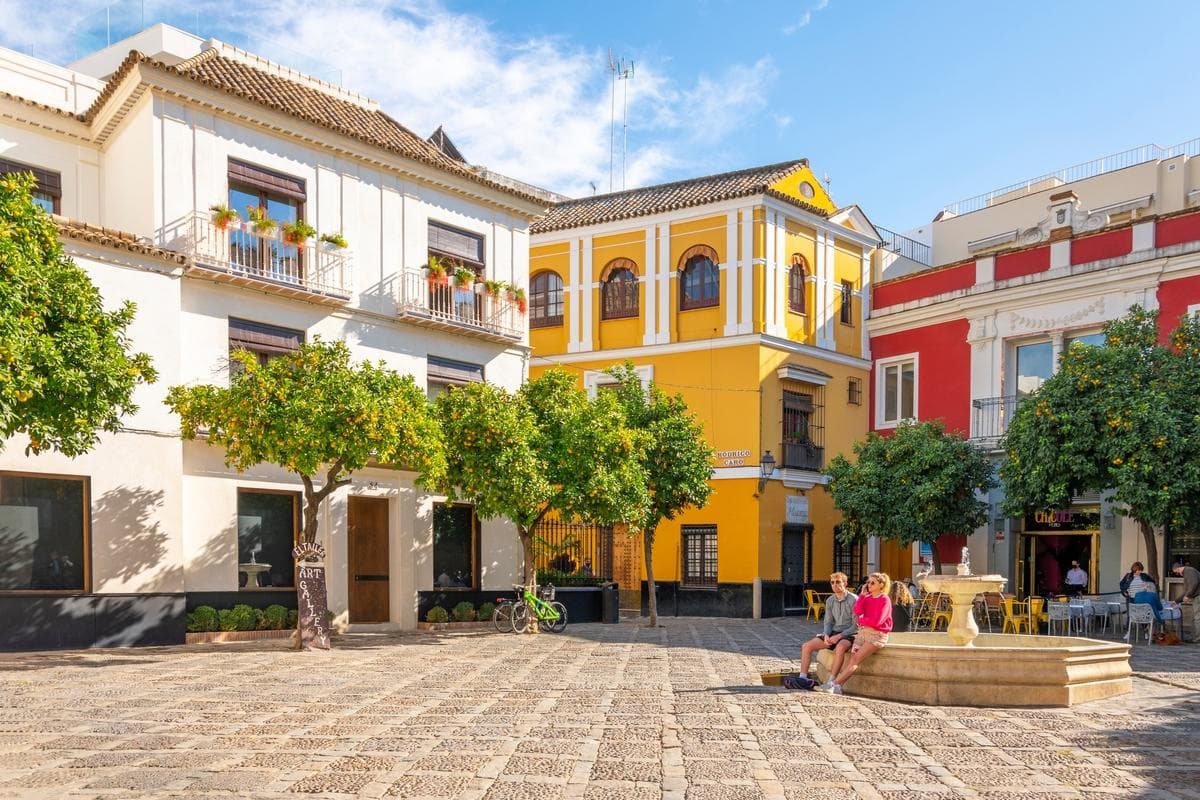
A stone's throw from the Royal Alcázar of Seville, Santa Cruz makes sense once you understand how it's built. Its narrow, winding streets aren't decorative — they answer a practical need: fighting the heat. That's why shade and airflow turn up where you least expect them, and the walk changes with every corner.
That same layout also tells its history. Although the quarter was built in the Muslim era, over time it became the place where the Sephardic Jewish community settled after the Christian conquest. That mix explains why, in such a small area, you find traces linked to all three great monotheistic religions, in specific corners and names such as Susona or the Plaza de Santa Cruz.
The visit is also framed by very recognisable surroundings. Right against the quarter stand the walls linked to the Alcázar's orchard and, next to them, the Jardines de Murillo, associated with the painter born in this area. Among its squares and alleyways it's easy to see why Santa Cruz has been a backdrop for figures such as José Zorrilla or Luis Cernuda, who left their mark on how Seville is told.
From an Andalusi layout to a Sephardic quarter by the Alcázar
The Santa Cruz Quarter is an urban fabric designed to work when Seville's heat presses hardest. Very narrow streets, constant turns and continuous shade make the walk here different from other, more open parts of the city — and it really shows in summer, when that difference is genuinely welcome.
Although it was born in the Muslim era, the quarter's role changed over time. After the Christian period, this area became associated with Sephardic Jews, and part of its current identity comes from there, since within a few hundred metres you find traces and stories linked to Muslims, Christians and Jews alike.
Its closeness to the Royal Alcázar of Seville also explains a lot. The quarter grows literally up against its boundaries, in the shadow of its walls and the Alcázar's orchard, which is why the area mixes an old street layout with a monumental edge that keeps appearing here and there.
Over the centuries, Santa Cruz has also become a quarter that's been written about. Its connection to Murillo is remembered in the Jardines de Murillo, and the literary legacy of José Zorrilla or Luis Cernuda helps explain why legend and memory carry as much weight here as the stonework itself.
A walk through Santa Cruz with 8 essential stops
1. Jardines de Murillo and the edge of the Alcázar's walls
Right against the quarter are the Jardines de Murillo and, alongside them, the walls linked to the Alcázar's orchard. This isn't just a green stroll — it's the physical boundary that explains why Santa Cruz grows so close to power, and why the quarter always seems to sit in the shadow of the monumental complex.
2. Plaza de Doña Elvira
This is one of those squares that work as a natural break in the maze: a reminder of an old French-era gunpowder store turned into a square. It's a good place to see a typical Santa Cruz contrast — an intimate setting and everyday neighbourhood life in a spot that once had a very different use.
3. Plaza de la Alianza
This square is often used to explain a key idea about the quarter: coexistence, and the story of the union of the three cultures that form part of Seville's memory — Muslims, Christians and Jews. It's a stop that matters less for its architecture and more for what it represents within the walk.
4. Calle Susona
There's no need to pad it out with invented legends — the name alone already tells you enough. Susona is a clear example of how, in Santa Cruz, history sticks to the street map itself, forcing you to read the quarter as a place with layers, not as a stage set.
5. Plaza de Santa Cruz
The square that gives the quarter its name captures that feeling of walking through a place that's lived through very different periods: within a few metres you find traces linked to the three monotheistic religions, not as an abstract idea, but as a real, recognisable mark on the place.
6. Parroquia de Santa María la Blanca
This church is a stop that carries its own weight, for a very concrete reason: it's a surviving relic of the Lisbon Earthquake, which also struck Seville. The visit gains context here, because you're not just looking at a church — you're seeing which events shaped the city and what was left standing.
7. Calle Mariscal
One of the quarter's most direct, physical landmarks. Calle Mariscal is the narrowest street in Seville, at around a metre wide. It's not just a fun fact — it helps explain the type of urban fabric that dominates Santa Cruz, and why the sun behaves differently here.
8. Hospital de los Venerables Sacerdotes
A building with a clear role in historic Seville: it was a residence for the Cathedral's elderly clergy. It's a stop that adds an institutional and religious dimension to the walk, balancing the visit between streets, squares and buildings that all played a real part in the city.
When to visit the Santa Cruz Quarter
In the morning, the narrow layout does its job and the walk feels light, with constant shade and airflow between the façades. Before sunset, a different side appears — a lower light that reaches into squares and alleyways and shows off the domestic architecture, courtyards and façade details without the sun beating down.
In summer this isn't just a nuance — it's practical: Seville can push close to 45°C, and here it's easy to feel exactly when the quarter's design is protecting you and when the heat simply takes over.
Guided tours of Santa Cruz
If you want a direct dive into medieval Seville, the best option is to book the Santa Cruz Quarter Free Tour, since it centres the whole experience on this area and follows the route that best explains its layers. If you'd rather adapt it to your own pace or interests, you can also do it as a private tour. And if you'd like to fit Santa Cruz into a fuller day, it combines well with a visit to the Royal Alcázar, the Cathedral, or a full Seville tour.
Book your guided tour
Want to see it with an official guide telling you about it in person?