25 cosas imprescindibles que hacer en Sevilla
Written by official guides
Seville needs a minimum of 1 day to see the basics, 2 days to enjoy it and 3 to understand it. This guide organises the 25 experiences that are really worth it, from the Royal Alcázar where Game of Thrones was filmed to the bar in Triana where Manolete had breakfast before fighting.
With 1 day you see the UNESCO triangle (Cathedral, Royal Alcázar, Archivo de Indias), Santa Cruz and Plaza de España. With 2 days you add Triana, Las Setas and a flamenco tablao. With 3 days you get into museums, climb secret viewpoints and have time for Itálica, the Roman amphitheatre where Trajan and Hadrian were born.
The whole city is walkable: 4–5 km from end to end. In summer (June–September) the thermometer passes 40 °C; better in spring or autumn. Holy Week and the April Fair are spectacular, but prices triple. And yes, in August Seville empties: many Sevillians flee to the beach.
THE 25 BEST THINGS TO DO IN SEVILLE
Every experience on this list is here for a reason:
The Royal Alcázar because it is the official residence when the King visits Seville.
The Giralda because you climb it by ramps, something unique among medieval towers.
Triana because it was the cradle of flamenco and keeps the mix of cultures that made it possible.
Las Setas (Metropol Parasol) because since 2011 they have changed the skyline of a city with 2,000 years of history.
It includes the most recommended (Cathedral, Plaza de España) and what Sevillians know, like the Feria market on Thursdays or the lesser-known viewpoint of the Metropol.
1. Royal Alcázar of Seville (2–3 hours minimum)
The oldest royal palace still in use in Europe is an architectural mix that should not work but does. Pedro I the Cruel built it in 1364 on the old Almohad palace and every monarch added his part without destroying what came before: Mudéjar with Gothic, Renaissance with Baroque, all fitting into 17,000 m².
The Patio de las Doncellas was the Palace of Dorne in Game of Thrones. The Hall of Ambassadors boasts a gilded muqarnas dome of 3,000 pieces representing the cosmos. The Baths of María de Padilla are not baths: they are 12th-century cisterns where today you walk between arches reflected in the water.
The gardens cover 7 hectares: a myrtle maze from 1914, peacocks roaming free since the 1950s and the English Garden where Alfonso XIII used to hide. In summer they hold the Nights in the Gardens of the Alcázar with concerts until September.
2. Seville Cathedral and the Giralda (2 hours)
The largest Gothic cathedral in the world was born on the old Almohad mosque. In 1401 the chapter decided: let us build a church so beautiful and so grand that those who see it finished will take us for madmen. A century later they had 11,520 m² and 42 metres of height in the central nave.
Inside is the tomb of Christopher Columbus carried by four kings (Castile, León, Aragon, Navarre). The high altarpiece has 45 carved biblical scenes covered with 2,500 kilos of gold. The stuffed crocodile in the Patio de los Naranjos was a gift from the Sultan of Egypt in 1260 when he asked for the hand of Alfonso X's daughter.
You climb the Giralda by 35 ramps, not stairs. The muezzin rode up on a donkey five times a day. Its 104 metres made it the tallest building in Spain for 800 years. At the top are 24 bells, each with its own name. The largest, Santa María la Mayor, weighs 5,000 kilos. The Giraldillo crowning the tower (4 metres, 1,300 kilos of bronze) turns with the wind.
3. Santa Cruz quarter (1 hour strolling)
Seville's old Jewish quarter is a labyrinth designed for getting lost. The streets are so narrow that in Reinoso (the street of Kisses) the balconies on either side almost touch. The Muslim layout aimed to create shade and air currents: it works so well that the temperature drops 5 degrees compared with the avenues.
The Callejón del Agua runs along the Alcázar wall and was where water carriers filled their pitchers. Plaza de Doña Elvira has the most photographed orange trees on Instagram. At number 5 Susona, the skull of Susona Ben Susón, the Jewish girl who betrayed her father for love of a Christian, hung for centuries.
The Murillo Gardens mark the edge of the district with remains of the Almohad wall. The Hospital de los Venerables (now the Velázquez Centre) has a courtyard worth the €5 entry. Murillo, who lived and died in the district, is buried in Plaza de Santa Cruz.
4. Plaza de España and María Luisa Park (1h 30min)
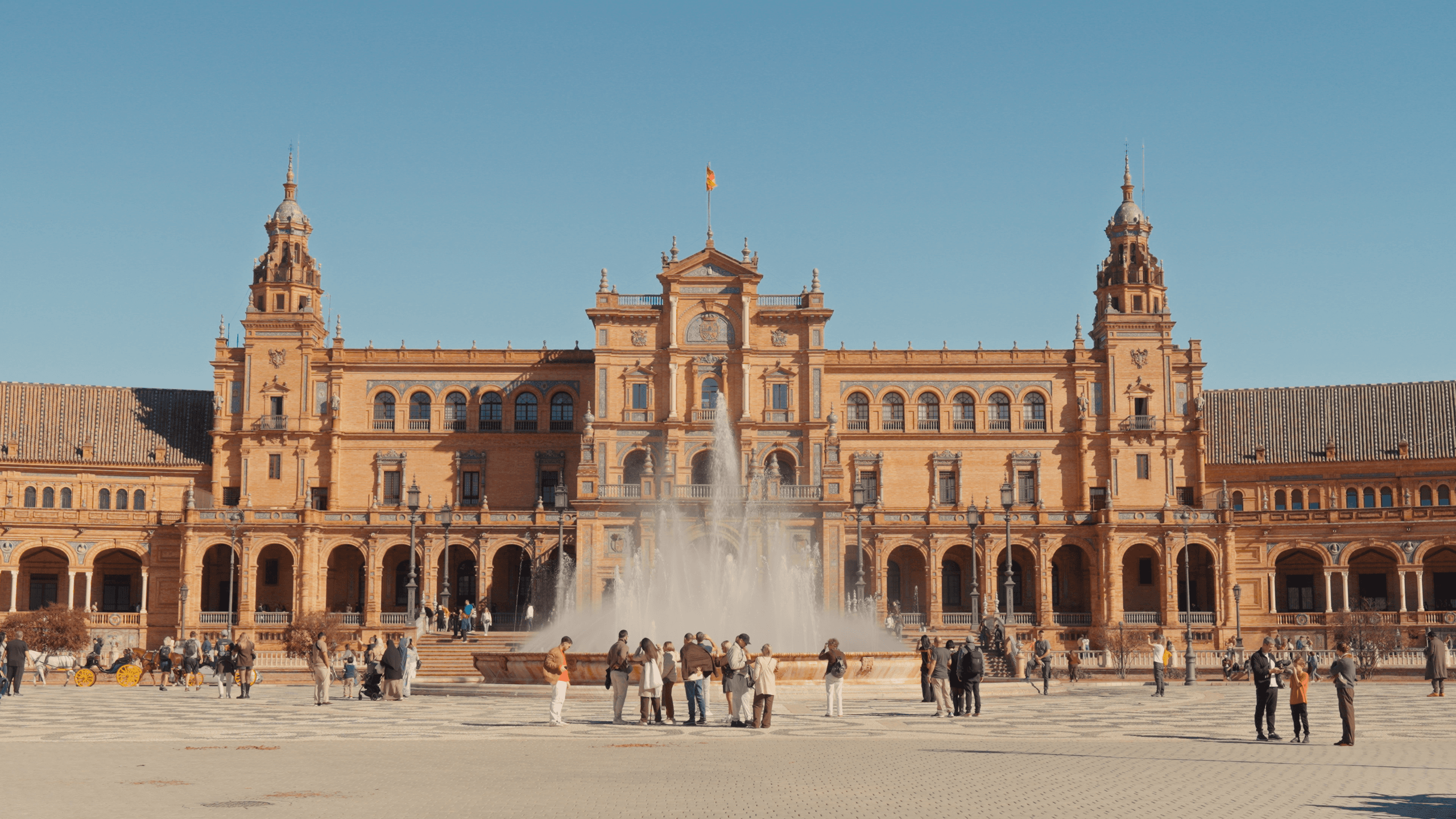
Plaza de España was built for the Ibero-American Exposition of 1929 and is a geography lesson in tiles. The 48 provincial benches are in alphabetical order except Navarre (listed as Pamplona). Seville has no bench because the whole square represents it. The 515-metre canal can be rowed by boat (€6, 35 minutes) and the four bridges represent the old kingdoms of Spain.
Lawrence of Arabia (it was the British headquarters in Cairo), Star Wars Episode II (the square of Naboo) and Sacha Baron Cohen's The Dictator were filmed here. The trick for photos with no people: come at 8:30 in the morning or during the Sevilla/Betis match.
María Luisa Park was the former private gardens of the Palace of San Telmo, donated by Infanta María Luisa in 1893. It has 3,500 trees of more than 200 species, the Glorieta de Bécquer with his bust, Monte Gurugú (an artificial hill with a waterfall) and Plaza de América with the three pavilions of the 1929 Ibero-American Exposition: the Mudéjar Pavilion (today the Museum of Popular Arts and Traditions), the Royal Pavilion (offices) and the Renaissance Pavilion (Archaeological Museum, where pieces such as the Carambolo Treasure have been displayed).
5. Torre del Oro and the Guadalquivir walk (45 minutes)
The Torre del Oro is a 36-metre Almohad albarrana tower that watched over Seville's port from 1220. It gets its name from the golden gleam of its tiles reflected in the river, not because it held gold from America (that went straight to the Alcázar). It was joined by a chain to another tower across the river to control shipping.
Inside is a tiny Naval Museum (€3) with models and old maps. It is better seen from outside at sunset, when the sun hits it full on and you understand the name. The walk from the Tower to the Triana bridge is 800 metres of riverbank with Triana opposite, benches in the shade and terraces where a beer costs €2.50, not the €4 of the Cathedral.
Guadalquivir cruises (€15, 1 hour) leave from here. They tell you that Magellan set sail from this river in 1519 and that the port moved to Cádiz in 1717 when ships became too big to sail up to Seville.
6. Triana and Calle Betis (2 hours with tapas)
Triana was where those who could not enter Seville lived: sailors, potters, gypsies. From that forced mix, flamenco was born. Cross the Isabel II Bridge (the Triana bridge) and you are in another world. The Chapel of the Sailors holds the Esperanza de Triana, which goes out in the early hours of Good Friday. The Castle of San Jorge was the seat of the Inquisition; now there is a market on top and remains you can visit for free in the basement.
Calle Betis is the riverbank with views of Seville. Here Rodrigo de Triana shouted "land!" on sighting America (a lie: he was on the caravel Pinta). The Callejón de la Inquisición is where heretics were burned. Calle Alfarería has kept pottery workshops since the 13th century: the tiles of Plaza de España were made here.
For tapas: Las Golondrinas (pringá roll), Bar Santa Ana (pork cheek), La Azotea if you want something more modern. On Thursdays the Triana Market has food stalls until midnight.
7. Las Setas (Metropol Parasol) and Plaza de la Encarnación (1 hour)
Metropol Parasol is one of the largest wooden structures in the world: 150 × 70 m and 26 m high. Designed by Jürgen Mayer and finished in 2011, it was built over Roman remains found during the works.
Up top, the panoramic walkways (€5) offer 250 m of undulating route with 360° views: the Giralda, the Cathedral, San Luis de los Franceses and even Castilleja de la Cuesta on clear days. In the basement, the Antiquarium (€2.10) preserves 1st-century Roman mosaics and a 12th-century Almohad house.
Plaza de la Encarnación keeps its tradition as a food market active since the 19th century. On Thursdays there is an antiques market and the market bars serve traditional breakfasts at a good price.
8. Archivo General de Indias (45 minutes)
Third vertex of the UNESCO triangle with the Cathedral and the Alcázar, the former Merchants' Exchange (begun in 1584 by Juan de Herrera) was turned into an Archive by Charles III in 1785 to centralise the documentation of America.
Today it holds millions of pages and maps linked to Columbus, Magellan, Cortés and Pizarro. The visit covers the monumental Herrerian courtyard and the marble main staircase. Entry is free and there is usually little queue. The temporary exhibitions change regularly.
9. Church of El Salvador (45 minutes)
The second-largest church in Seville rises on the great mosque of Ibn Adabbas (9th c.). The courtyard keeps remains of the ablution area and a century-old orange tree. The current Baroque church was built between 1674 and 1712.
Inside, the highlights are the high altarpiece by Cayetano de Acosta (Transfiguration), the Cristo del Amor by Juan de Mesa (1620) and, in the sacramental chapel, Jesús de la Pasión by Martínez Montañés. In the crypt you can see remains of the mosque with horseshoe arches.
Buy the combined Cathedral + Salvador ticket (€11): you save time and it gives access through the Puerta de San Cristóbal at the Cathedral.
10. Casa de Pilatos (1 hour)
The most beautiful palace in Seville after the Alcázar mixes Mudéjar, Gothic and Renaissance because the first Marquis of Tarifa came back from Jerusalem in 1519 wanting to recreate the house of Pontius Pilate. The result is two breathtaking courtyards: the Main Courtyard with 24 busts of Roman emperors and 16th-century tiles, and the Large Garden with its loggia of Carrara marble columns.
The staircase covered by a gilded dome from 1537 was the first of its kind in Seville. The 150 tile works are the best collection of 16th-century Sevillian ceramics. On the upper floor (€3 extra) are the private apartments with coffered ceilings and frescoes by Francisco Pacheco, Velázquez's master.
Lawrence of Arabia (it was Jerusalem), Ridley Scott's 1492 and Knight and Day with Tom Cruise were filmed here. Full ticket €12, ground floor only €10. On Mondays from 15:00 to 19:00 it is free for EU residents.
11. Basilica of La Macarena (30 minutes)
La Macarena is not just a basilica, it is a feeling. Built in 1949 to house the Virgen de la Esperanza Macarena, the most venerated image in Seville, with respect to the Esperanza de Triana. In the early hours of Good Friday 2,500 penitents go out with her and the city comes to a standstill.
The virgin is an anonymous 17th-century work, although legend says it was carved by a woman, Luisa Roldán. The five gold ladybird brooches she wears were a gift from a bullfighter. The canopy weighs 2,500 kilos and needs 36 bearers. The museum (€5) has the gold-embroidered mantles, the float of the Cristo de la Sentencia and the full trousseau.
The Macarena Arch next to the basilica is one of the few surviving gates of the 12th-century Almohad wall. The 400 metres of preserved wall run to the Parliament of Andalusia.
12. Feria Market (1 hour on Thursdays)
The oldest street market in Spain (since 1296) is set up on Thursdays in Calle Feria. Three kilometres of stalls with everything: clothes for €5, olives by weight, spices, old ironmongery, vinyl, second-hand books, plants, birds. Gypsies sell live snails in sacks, antique dealers treasures among scrap.
The Feria Food Market (an iron building from 1719) opens daily with fresh fish from Puerto de Santa María and vegetables from the Vega. The market bar serves hearty breakfasts for €3: mollete with manteca colorá, coffee and fresh orange juice.
The Alameda de Hércules is at the end of the street. It was the first public garden in Europe (1574). The two Roman columns brought from Calle Mármoles bear statues of Hercules and Julius Caesar, mythical founders of Seville. An alternative nightlife area.
13. Palacio de las Dueñas (1 hour)
The palace of the House of Alba where Antonio Machado was born (his father was the administrator) and where Cayetana married in 1947. It is 5 buildings joined by courtyards from the 15th to the 18th centuries. The Lemon Tree Courtyard has 19 varieties of citrus. The Santa Justa Garden keeps an Arab cistern. The bougainvillea in the main courtyard is more than 100 years old.
The halls hold works by Luca Giordano and Madrazo and documents signed by Columbus. The chapel has a Christ by Pedro Roldán. The archive holds Cayetana's love letters and the scores Turina composed here. Jackie Kennedy took tea in the Salón de la Gitana in 1966.
Entry €12. On Mondays from 16:00 to 18:00 reduced entry of €10. The poet Juan de Mena died here in 1456 of a seizure while reading.
14. Hospital de los Venerables (45 minutes)
This Baroque hospital for elderly priests (1675) is now the Velázquez Centre with the best collection of the painter in Seville. The courtyard with its double gallery of arches is a marvel of proportion. The church has frescoes by Valdés Leal and his son Lucas Valdés that fool the eye with false architecture.
The high altarpiece is by Pedro Roldán, with sculptures that seem to breathe. Velázquez's Saint Rufina (1630) was lost for centuries until it turned up in a private collection. Murillo's Immaculate Conception was saved from Napoleonic plunder by hiding it in a private house.
Entry €12 with audio guide. Sundays at 17:30 free entry for residents. The courtyard appears in the opera Carmen as the tobacco factory.
15. Museum of Fine Arts (2 hours)
The second art gallery in Spain after the Prado occupies the Convent of La Merced (1612). The Murillo collection is the best in the world: 18 works including the 4-metre Colossal Immaculate. The Zurbaráns in the refectory with their white monks are hypnotic. Zurbarán's Saint Hugh looks like a photograph.
The main cloister with 17th-century Sevillian tiles is where you feel best. The pink marble imperial staircase has a dome painted by Domingo Martínez. The Valdés Leal rooms show his darkest vanitas: In ictu oculi and Finis gloriae mundi.
Entry €1.50, free for EU citizens. Tuesdays from 15:00 to 20:00 free entry for all. Powerful air conditioning, a lifesaver in summer.
16. Plaza Nueva and City Hall (30 minutes)
Plaza Nueva is the nerve centre, although it is no longer new (it dates from the 15th century). The equestrian statue of Ferdinand III presides over the square, the king who took Seville from the Muslims in 1248. The City Hall has two façades: the 16th-century Plateresque one facing San Francisco and the 19th-century Neoclassical one facing Plaza Nueva.
In the City Hall archway is Andalusia's kilometre zero. The medallions on the façade depict Hercules, Julius Caesar and historical figures. Grace Kelly has had one since she visited the city in 1966. The Columbus Hall (free guided visits on Saturdays) has the banner Ferdinand III carried in the conquest.
The La Campana confectioner's (1885) on the corner keeps its original Modernist counter. Its yemas and tocinos de cielo follow the recipe of the nuns of San Leandro.
17. Church of San Luis de los Franceses (30 minutes)
Seville's hidden Baroque jewel. The Jesuits built it (1699–1731) to impress, and they certainly succeeded. The dome painted with the apotheosis of Saint Aloysius leaves your neck aching from looking up. The mirror altarpieces multiply the light to infinity.
The architect Leonardo de Figueroa was inspired by Il Gesù in Rome but surpassed it. The Solomonic columns seem to move. The frescoes by Lucas Valdés tell the life of Saint Aloysius in Baroque technicolour. The 18th-century organ still works, with occasional concerts on Sundays.
Free entry. Open Tuesday to Sunday only. The crypt (closed to the public) holds mummies of 18th-century Jesuits.
19. Itálica and Santiponce (3 hours with transport)
The Roman amphitheatre where the emperors Trajan (53 AD) and Hadrian (76 AD) were born is 9 km from Seville. With room for 25,000 spectators, it was the third largest in the Empire. The central pit had lifts to raise wild beasts. The underground galleries keep the gladiators' cells.
The mosaics of the patrician houses are extraordinary: the House of the Birds with 30 different species, the House of Neptune with the sea god, the House of the Planetarium with the seven planets then known. The baths keep the hypocaust heating system (hot air under the floor).
Bus M170A from Plaza de Armas (€1.60, 30 minutes). Entry €1.50, free for EU citizens. The Monastery of San Isidoro del Campo in Santiponce (same village) has the altarpiece by Martínez Montañés where Guzmán el Bueno is buried.
20. Alameda de Hércules (1 hour with a vermouth)
The oldest square in Europe (1574) is where Sevillians go when they flee the tourist centre. The two Roman columns with Hercules and Julius Caesar come from the Roman temple on Calle Mármoles. On Sundays there is a flea market of old books, vinyl and antiques.
Casa Morales (1850) serves wine from its own century-old jars. El Garlochí is a brotherhood bar lined with virgins and Christs, with vermouth on tap. La Cacharrería has a terrace under the trees, perfect for the late afternoon. Torres y García has sold marinated olives since 1914.
At night it changes: alternative bars, live music, LGBTQ+ atmosphere. The Teatro Alameda programmes experimental flamenco. On Thursdays there is a jazz jam session at Café Central.
21. Calle Sierpes and the shopping area (1 hour if you shop)
The most famous pedestrian street runs from La Campana to San Francisco. This is where the indianos who came back rich from America shopped. El Cronómetro (1901) repairs impossible watches. Sombrerería Maquedano (1898) made Indiana Jones's hat. Papelería Ferrer (1856) is the oldest stationer's in Spain.
The Chapel of San José is inside the street, a miniature Baroque. The Palace of the Countess of Lebrija (€12) has the best Roman mosaics in Seville, brought from Itálica. La Campana (1885) in the square of the same name invented tocino de cielo.
On Thursdays everything closes at 22:00 for shopping night. Big sales in January and July. The parallel Calle Tetuán has the mainstream brands.
22. Flamenco Dance Museum (1 hour)
Cristina Hoyos opened this museum in 2006 in an 18th-century palace in the heart of Santa Cruz. It is not your typical boring museum: interactive screens teach you the difference between soleá, bulería and seguiriya. The costumes of Matilde Coral and Antonio Gades tell the story of the dance. Antonio Ruiz Soler's shoes are worn from so much footwork.
The courtyard has daily shows at 17:00 and 19:00 (€22). They are professional dancers, not the tourist show. The shop sells professional castanets and hand-painted fans. The beginners' flamenco classes (€15) on Wednesdays at 18:00 teach you the basic rhythm.
Museum entry €10, with show €24. The rooftop on the top floor has views of the Giralda and serves rebujito in summer.
23. Triana Ceramics Centre (45 minutes)
The former Santa Ana Ceramics factory (1870) is now a museum of Triana's pottery tradition. The bottle kilns in the courtyard are the only ones left of the 44 there once were. The tiles of Plaza de España were fired here: 35,000 square metres of ceramics.
The whole process is explained: from clay to glazed tile via moulds, kilns and hand painting. The Mensaque collection has pieces from the 16th to the 20th centuries. The giant lebrillos were used for washing clothes. The 16th-century baptismal fonts by Niculoso Pisano are still in churches all over Andalusia.
Entry €2.10, free on Saturdays from 14:00. The demonstration workshop on Fridays at 11:00 shows traditional wheel-throwing. The shop sells reproductions of historic tiles at factory prices.
24. Flamenco tablao (1h 30min with a drink)
Tablaos are not tourist traps if you choose well. Casa de la Memoria (€22) is intimate, 60 people maximum, no microphone. La Casa del Flamenco (€22) is in the courtyard of a 15th-century palace-house. El Arenal (€38 with a drink) is the oldest (1975), where Camarón sang.
Avoid the ones that include dinner: the food is mediocre and expensive. Better to eat first and go just for the show. The 19:00 shows are the same as the 22:00 ones but cheaper. On Mondays many close; it is flamenco's day off.
Los Gallos in Santa Cruz (1966) is where celebrities were taken, from Hemingway to Obama. Casa Anselma in Triana has no scheduled show; the 80-year-old owner sings when she feels like it. Free entry but you must buy a drink.
25. Food markets (1 hour with an aperitif)
The Triana Market over the old Castle of San Jorge has traditional stalls downstairs and gastro-bars upstairs. On Thursdays from 20:00 to midnight they set up international food stalls. The Lonja del Barranco (by Eiffel, the one of the tower) is pure iron from 1883 converted into a gourmet market.
The Encarnación Market is the most authentic: fishmongers shouting, butchers cutting, greengrocers who give you parsley for free. Bar Manolo inside the market makes pork-cheek-and-tomato breakfasts for €3. La Alacena in the Feria Market is legendary for its snails (May to September).
Traditional market hours: 8:00–14:30. On Mondays many stalls close. Saturdays until 15:00 with more atmosphere. The gourmet markets open until midnight.
Essential tours and guided visits in Seville
After analysing reviews and trying dozens of tours, these are the visits we recommend. The free tour is perfect for the first day: it gets you oriented for free. The visits with tickets included to the Alcázar and Cathedral skip the 45–90-minute queues in high season. The food tours take you to bars you would not enter on your own. And the night routes tell the murky history the official brochures leave out.
They all need advance booking, especially April–May and September–October when groups fill up 2–3 days ahead. Prices range from a free contribution on the free tours to €59 for the complete visits with all tickets.
Free tour of Seville – the essential one to start with (2h 30min)
The free tour of the historic centre is the best introduction to Seville. In 2 and a half hours you cover the whole UNESCO triangle: the Cathedral (exterior), the Giralda, the Royal Alcázar (façade and Lion Gate), the labyrinth of the Santa Cruz quarter, the Torre del Oro and you finish in Plaza de España.
The local guides point out details you would miss: where Don Fadrique's blood is after 700 years, why the Giralda has 34 ramps, or the Navarre bench that breaks the alphabetical order in Plaza de España.
It works on a free contribution (€10–15 per adult is usual). Groups of 25 people maximum. Booking required.
Guided visit to the Royal Alcázar of Seville (1h 15min)
The guided visit to the Royal Alcázar with tickets included lets you understand the oldest royal palace in use in Europe. The official guide explains the impossible mix of styles (Mudéjar, Gothic, Renaissance), takes you through the Patio de las Doncellas (Dorne in Game of Thrones), the Hall of Ambassadors with its gilded dome, the Baths of María de Padilla and the 7-hectare gardens.
From €36 with skip-the-line ticket included. Save 45–90 minutes of waiting in high season. The guide points out details such as the original 14th-century tiles or the stonemasons' marks.
Guided visit to the Cathedral and Giralda (1h 15min)
The largest Gothic cathedral in the world needs context to be understood. The visit includes the tomb of Columbus, the 400 m² high altarpiece, the Patio de los Naranjos and the climb up the Giralda by its 35 ramps. The guide explains why a crocodile hangs there, where his son is buried or what Amerigo Vespucci is doing in a chapel.
From €32 with skip-the-line ticket. The free Monday slot (16:30–18:00) is chaos, better to avoid it.
Complete tour: Royal Alcázar + Cathedral and Giralda (3 hours)
The combined visit is the most efficient: a single guide, tickets to both monuments and no queues. In 3 hours you see the essentials of the two UNESCO monuments with explanations that connect them: the same artists, the same history, the same kings.
From €59 all inclusive. The guide manages the timing so you see what matters without stress. Ideal if you have 1–2 days in Seville.
Tour of the Santa Cruz quarter (2 hours)
The old Jewish quarter needs a guide so you do not get lost (literally) and can understand its impossible streets. The route includes the Callejón del Agua, Plaza de Doña Elvira, the street of Kisses (Reinoso), Susona's house and the Hospital de los Venerables.
From €15. The guide tells the real legends: the skull that hung for centuries, the diabolical grille no one can copy, where the real Don Juan lived.
If you are wondering what to see and do in Seville in 1, 2 and 3 days, here is the plan (2025 itinerary)
Today we bring you the diary of our 3-day route through Seville. It gives you a realistic idea of what fits into 72 hours, without rushing and enjoying it: mornings for the great monuments, afternoons in the shade in parks and neighbourhoods, and evenings of tapas or flamenco.
In three days you can go inside the Alcázar and the Cathedral with the Giralda, stroll Santa Cruz, devote an afternoon to Plaza de España and María Luisa Park, cross to Triana, climb Las Setas at sunset and add a bonus such as the Archivo de Indias, the Casa de Pilatos or even Itálica if you feel like getting a little out of the centre. With bookings made and a couple of timing tricks, the plan is flexible and can give you time for all the essentials. Let's start the itinerary!
Seville in 1 day
With 24 hours you have to choose between the Royal Alcázar or the Cathedral with the Giralda (2–3 hours either), there is no time for both inside. Then Santa Cruz on foot (45 min), lunch in the area (1 hour), Plaza de España and María Luisa Park (1h 30min) and finish with the sunset at the Torre del Oro or climbing Las Setas.
Total: 4–5 km on foot. Spend: €35–45 per person with entry to one monument, lunch and an extra or two. If you arrive by AVE in the morning and leave at night, there is time perfectly. In summer start before 10:00.
Seville in 2 days
Day 1: Royal Alcázar (early morning, 2–3 hours), Santa Cruz quarter until lunchtime, Plaza de España and María Luisa Park in the afternoon, sunset from Las Setas.
Day 2: Cathedral and Giralda (first thing, 2 hours), Archivo de Indias (45 min, free), cross to Triana for an aperitif on Calle Betis, afternoon for the Torre del Oro, Casa de Pilatos or Museum of Fine Arts depending on whether you prefer palaces or painting. Evening: flamenco tablao or tapas around the Alameda.
Now you can go inside the two great monuments, cross the river and even go back to that bar you liked.
Seville in 3 days
Day 1: full Royal Alcázar with gardens (3 hours), Santa Cruz at leisure, unhurried lunch, Plaza de España and María Luisa Park exploring the hidden glorietas.
Day 2: Cathedral, Giralda and Archivo de Indias (full morning), Casa de Pilatos (1 hour), lunch in the centre, afternoon in Triana with the market, Calle Betis and the Ceramics Centre. Flamenco tablao in the evening.
Day 3: Itálica in the morning (4 hours with transport), back for the Museum of Fine Arts (2 hours, closes at 15:00 on Sundays), afternoon for Las Setas, the Alameda de Hércules and whatever you have not seen. Or simply go back to that square that surprised you.
With 3 days you see everything without rushing, go back wherever you like and even have time to get lost without looking at the clock, with an optimised, complete itinerary like this one, updated by our guides in 2025.
The best tours, prices and activities in Seville
We organise the visits that are really worth it according to your time, budget and what you want to see. It is not the same if it is your first time in Seville as if you already know the basics.
If you are short of time, the combined Alcázar + Cathedral tour saves you 2 hours of queues (€59). If you are on a tight budget, the free tour of Santa Cruz orients you perfectly (free contribution, €10–15). For those looking for unique experiences, the Casa de la Memoria tablao.
If you arrive in Seville by car or plane, this is what you need to know
From San Pablo airport (SVQ). The EA bus is the most practical: €4 and in 35 minutes it drops you at Plaza de Armas or Prado de San Sebastián. From there it is a 10–15-minute walk to the Cathedral to start the route. It runs every 20–30 minutes.
If you arrive late or with luggage, the taxi has a fixed fare: €22.81 by day, €25.43 at night and on public holidays. In 15 minutes you are in the centre.
If you land before 10:00, leave your bags at the hotel and start with the Alcázar. If you arrive in the afternoon, go straight to Plaza de España or Triana.
If you come by car, free parking is possible. Do not try to drive into the historic centre: it is a pedestrian zone and the fines fly. Park in these places that work:
April Fair/Los Remedios area, next to the river; there is always space except during the Fair (April). 15 minutes' walk to María Luisa Park.
Calle Torneo (north area), close to the Alameda, 20 minutes to the centre.
And lastly, free at Kansas City–Santa Justa, if you do not mind walking 25 minutes.
If you prefer paid parking, there are the Jardines de Murillo (€25/day, next to Santa Cruz), Mercado de Triana (€20/day) or Plaza de Armas (€18/day).
6 final tips so you do not waste time or money in Seville
Buy tickets online. The Alcázar and the Cathedral sell out, especially from March to May and in October. In summer the queues under the sun are hell. Book at least 2–3 days ahead on the official websites. Mondays have a free slot but you still have to book.
The heat in Seville in summer. From June to September the thermometer passes 40º. Go out before 10:00, stop from 14:00 to 17:00 (compulsory siesta) and always carry water. The courtyards of the Alcázar and María Luisa Park are the only shady respites. In August, honestly, better not to come.
Everything is 15 minutes' walk. From the Cathedral to the Alcázar: 5 minutes. To Plaza de España: 15. To Triana: 20. To Las Setas: 10. Do not take a taxi to move around the centre; it is throwing money away. The tourist buses are a rip-off; the city is better seen on foot.
If you arrive by AVE at Santa Justa. Bus 32 drops you in the centre for €1.40. A taxi is €8–10 and is worth it with luggage. The station has lockers (€4–6/day) if you want to leave your bags and make the most of the day.
Sundays and public holidays. Many bars in Santa Cruz close. The Alcázar opens but with shorter hours. The municipal museums are free. Triana has more life than the centre on these days.
Do not try to do the route backwards. The order matters: monuments in the morning when there are fewer people, Plaza de España when the sun goes down for photos, and the Torre del Oro at sunset. If you start late, everything piles up.
Book your guided tour
Want to see it with an official guide telling you about it in person?