
Seville Cathedral, a World Heritage Site
Written by official guides
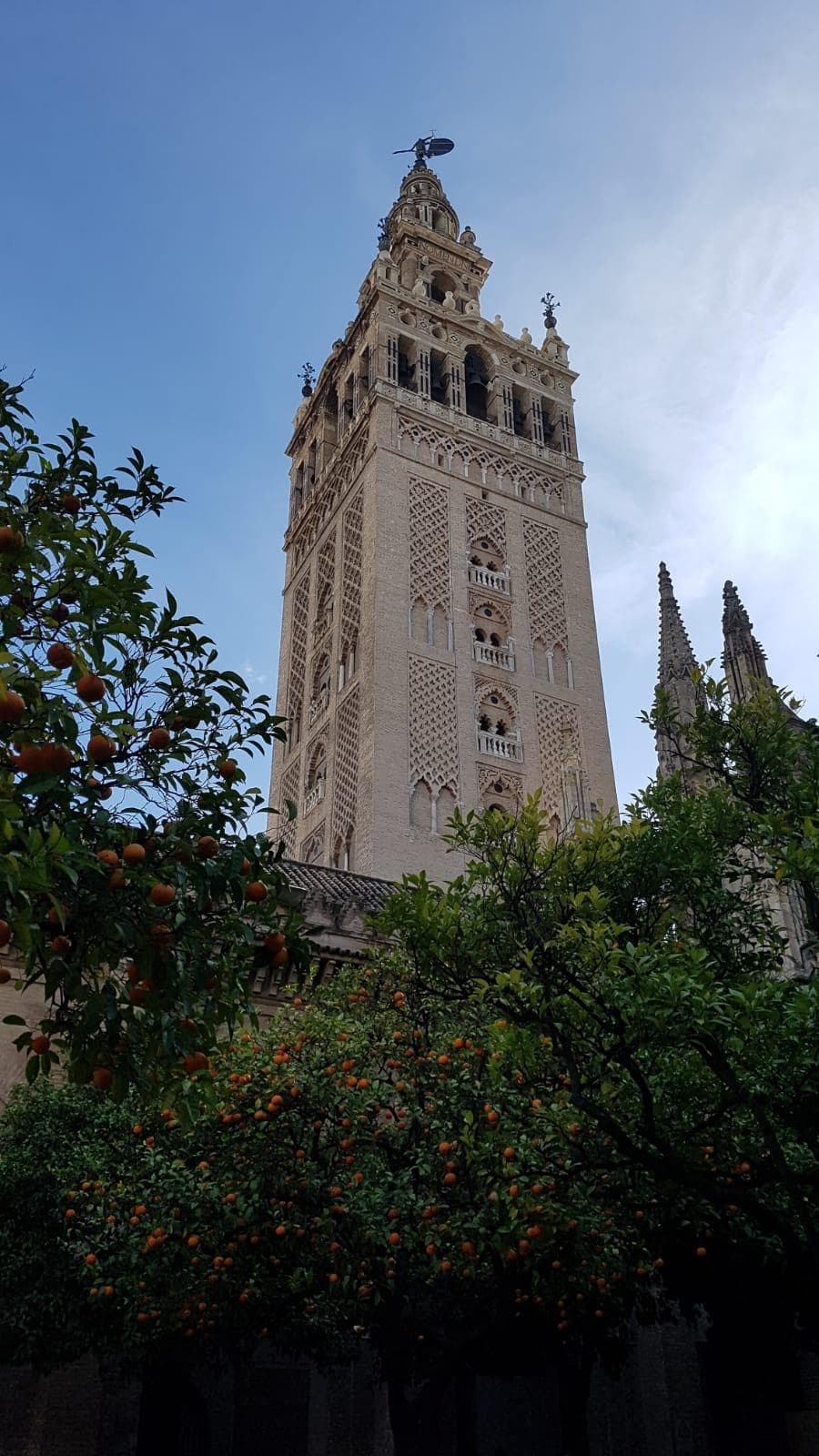
Seville Cathedral sits in the historic heart of the city, between the Santa Cruz quarter and the Guadalquivir river, and within a 100-metre radius it shares its surroundings with the Royal Alcázar and the Archive of the Indies.
It is the largest Gothic cathedral in the world and, by size, the third-largest church after St Peter's Basilica in the Vatican and St Paul's Cathedral in London. In 1987 it was declared a World Heritage Site by UNESCO.
History: from the Almohad mosque to the Gothic cathedral
Before it was a cathedral, this site held the great Aljama Mosque of Seville. In 1172 the Almohad caliph Abu Yaqub Yusuf ordered its construction, and it was completed in 1198. It was a rectangular building measuring 113 x 135 metres and 15,500 m², somewhat smaller than the mosque of Córdoba, but far bigger than any other mosque in Al-Andalus.
Part of the mosque's courtyard, once ringed by porticoes, still survives, along with its old minaret — today the Giralda — reused as a bell tower. Inside, the prayer hall took up roughly 60% of the complex and was organised into 17 naves separated by arcades on brick pillars, with a transverse nave along the qibla wall.
After the Christian conquest of Seville in 1248 by Ferdinand III, the mosque became a Christian church and its structure was respected for a time. In 1401 the idea arose of raising a new building on a scale never seen before, and by the early 15th century demolition of the old mosque began to make way for the great Gothic cathedral. Work on the new church started in 1433 and continued under different master builders until key elements such as the dome were completed in the 16th century.
The must-see interior: the Main Altarpiece, the Choir and the Royal Chapel
Inside Seville Cathedral, the first great landmark is the Capilla Mayor, which occupies a section of the central nave. Here you understand why people call this an overwhelming church: you're standing at its liturgical heart, and just a few steps away the key pieces begin to unfold.
The absolute star is the Main Altarpiece, in Gothic-Mudéjar style, considered the largest in Christendom. It was carved in stages over nearly a century, between 1482 and 1564, following the design of Pyeter Dancart, with the participation of masters such as Pedro Millán, Jorge Fernández Alemán, Alejo Fernández, Roque Balduque, Juan Bautista Vázquez the Elder and Pedro de Heredia.
Facing the altarpiece stands the Choir, also Gothic-Mudéjar, with stalls carved between the 15th and 16th centuries. The set also includes wrought-iron grilles and 16th-century pulpits by Fray Francisco de Salamanca, which visually frame the area.
And if there's a space that connects history and city, it's the Royal Chapel, conceived as a pantheon: here stand the Virgin of the Kings, with her altar, and the sarcophagi of Ferdinand III and Beatrice of Swabia, alongside that of Alfonso X. In front of the altar is kept the gilded silver and glass urn holding the incorrupt body of St Ferdinand, shown every 30 May.
Artistic treasures and Christopher Columbus's mausoleum
Seville Cathedral isn't defined only by its size or architecture. Given how many works of art it holds, it can feel almost like a museum. Among its artistic treasures are paintings by Bartolomé Esteban Murillo, the 17th-century Sevillian painter, alongside works by Zurbarán, Goya and Pedro de Campaña, among others.
And there's one piece that many visitors come looking for directly: the Mausoleum of Christopher Columbus. It's the work of Arturo Mélida and stands in the right arm of the transept. Here rest the remains of the famous discoverer of America.
The Giralda: from Almohad minaret to bell tower
The Giralda was the minaret of the old Almohad mosque and is one of the pieces from that complex that has survived to this day. Over time it was repurposed as a bell tower, which is why its presence is so closely tied to the building's history: it's the element that most visibly connects the Islamic era with the Christian cathedral.
On today's visit, access to the Giralda is included together with the Cathedral, so it's considered part of the same tour.
Opening hours, tickets and free access
The visit is combined with the Cathedral and access to the Giralda. Monday to Saturday, general opening hours run from 10:45 to 17:00. On Sundays, visiting hours are 14:30 to 18:00.
In summer, Monday to Saturday hours extend to 10:45–18:00, with the ticket office open until 17:00. In July and August (except 17 and 25 July), hours run 10:30–18:00, also with the ticket office open until 17:00. On Sundays in July and August you can visit from 12:00 to 18:00, with the ticket office open until 18:00.
Closed: 1 and 6 January and 25 December. Reduced hours (11:00–13:00): 5 January, 24 December and 31 December.
There's free admission on Sundays from 16:30 to 18:00, booking online in advance.
Tickets: general admission €13, reduced admission €7 for pensioners and students up to 25. Free for residents of the Diocese of Seville, children up to 13 accompanied by an adult, people with a disability rating above 65% (with a free companion if strictly required) and unemployed visitors.
Curiosities and legends of the Cathedral
One of the most striking stories is about gifts that ended up staying in the church: inside the cathedral you can see an elephant tusk and a stuffed crocodile. As the story goes, the Sultan of Egypt sent them to Alfonso X the Wise as part of an attempted marriage alliance, along with other gifts, and although that marriage never happened, the gifts stayed in Seville.
There's also a lesser-known fact about the building itself: in 2006 it was discovered that its vaults expand several centimetres every day due to temperature changes, a movement that's been compared to breathing. Far from being a problem, it's seen as a structural advantage, since it shows the building has room to move under stress.
Another curious anecdote is that the Giralda has a replica in Kansas City, the result of the sister-city relationship between Kansas and Seville — a symbolic way of carrying the image of the Sevillian bell tower across the Atlantic.
And there's an architectural detail that surprises many people: although it's usually called a Gothic cathedral, its floor plan doesn't follow the typical Latin-cross scheme. That's explained by its origin, since it was built over the old main mosque, and that's why spaces like the Patio de los Naranjos or the Puerta del Perdón still show that legacy.
Finally, nearby you can see chains marking a historic boundary between the jurisdiction of the city and that of the Church. According to tradition, people who had committed minor offences could seek refuge in the cathedral under the protection of ecclesiastical law.
Guided tour of Seville Cathedral
If you're looking for a guided tour of Seville Cathedral, you can book ours from €31.
The tour helps you piece together the history: what remains of the Almohad mosque and how the great Gothic cathedral was later built on top of it. Along the way, the guide puts into context the must-see highlights: the Capilla Mayor, the Main Altarpiece made between 1482 and 1564, the Choir, the Royal Chapel with the pantheon of Ferdinand III, Beatrice of Swabia and Alfonso X, and the Mausoleum of Christopher Columbus.
Book your guided tour
Want to see it with an official guide telling you about it in person?