
Royal Alcázar of Seville
Written by official guides
The Royal Alcázar of Seville stands on Plaza del Triunfo, a plaza with an irregular layout that has borne this name since the 18th century, after the small monument known as El Triunfo. This monument, by José Tomás Zambrano, was erected in reference to the 1755 Lisbon earthquake and is crowned by the Virgin and Child, known as the Virgen del Triunfo or Virgen del Patrocinio.
This area brings together Seville's three World Heritage Sites: Seville Cathedral, the General Archive of the Indies and the Royal Alcázar, a complex of Christian palaces historically linked to housing kings and high-ranking figures.
Islamic origins: Isbiliya, 712, and the transformation of the site
Construction of the Royal Alcázar of Seville began after the arrival of Islamic culture in the city in the year 712, when Seville was known as Isbiliya. Since then the site grew as a palace complex built in stages, with buildings from different periods.
That historical continuity is visible right on Plaza del Triunfo itself. The section of wall seen from there includes Roman ashlar blocks that, during the Islamic period, were reused for the construction of these palaces — a detail that explains well how the Alcázar has been built up over what came before without ever completely erasing it.
From Ferdinand III to Alfonso X: the monarchs' Alcázar
After the Christian conquest of Seville by Ferdinand III in 1248, the Royal Alcázar passed into the hands of the monarchs and became tied to the life of the Crown. In fact, it's considered the oldest palace complex still in active royal use in Europe — an idea that makes sense once you see the site isn't a single building, but a sum of stages and renovations.
Already in the 13th century, Alfonso X the Wise, son of Ferdinand III, drove the first major renovations of the earlier palaces of Islamic origin. At that point three great Gothic halls were created, marking the start of a Christian transformation that didn't replace the complex overnight, but instead kept adding new pieces on top of what already existed.
Pedro I and the Mudéjar Palace: the great impact
The 14th century brought one of the decisions that most defines today's visit. King Pedro I, nicknamed the Cruel or the Just, ordered the construction of the Mudéjar Palace, which tends to be the most striking part when you enter the complex.
This palace holds much of the Alcázar's identity and acts as a bridge between periods, since it was built within a site that already carried centuries of history and would keep adding spaces afterwards. It's also here that one of the most special courtyards on the whole tour begins, the Patio de las Doncellas, directly linked to Nasrid Granada.
The Patio de las Doncellas: Nasrid craftsmen and Muhammad V
The Patio de las Doncellas is one of the most special spaces in the Mudéjar Palace, and it has a detail that makes it even more interesting: it dates from the same period as the Alhambra of Granada, one of the great legacies of Islamic culture that has survived to this day.
Important craftsmen from the Nasrid dynasty worked on this courtyard, sent by Muhammad V himself, the Nasrid sultan and one of Granada's most symbolic rulers. His relationship with Pedro I was close, and at the time the political alliance between a sultan and a Christian king drew a lot of attention, with mutual support on military and power matters.
That context explains why, within a complex of Christian palaces, there's a courtyard so strongly marked by Nasrid aesthetics. The Alcázar isn't a work from a single moment — it's a place where cultures cross paths and leave a real mark in stone.
Film and TV: the Alcázar in Game of Thrones and other productions
Beyond its historical value, the Royal Alcázar of Seville has served as the setting for several productions. Films such as Kingdom of Heaven and Alatriste were filmed here, as well as the TV series Game of Thrones, one of the most-watched productions worldwide.
That combination of palaces and gardens, with spaces from different periods, is what makes the Alcázar work so well as a filming location, and why many visitors recognise it from having seen it on screen before.
Opening hours, tickets, free access and the Cuarto Real Alto
In winter, from 1 October to 31 March, it opens Monday to Sunday from 09:30 to 17:00, with clearing starting at 17:45. In summer, from 1 April to 30 September, it opens Monday to Sunday from 09:30 to 19:00, with clearing starting at 19:45.
Closed on 1 January, 6 January, Good Friday and 25 December.
Every Monday, booking online in advance, there's free access from 18:00 to 19:00 between April and September, and from 16:00 to 17:00 between October and March.
General admission is €15.50. Reduced admission is €8 for pensioners over 65 and accredited students up to 30. Free admission applies to people born or resident in the municipality of Seville, children up to 13 accompanied by an adult, people with a disability rating above 33% (with a free companion if strictly required), unemployed residents of the province of Seville, and authorised people carrying out research or visual-arts work inside the site.
The optional visit to the Cuarto Real Alto runs from 10:00 to 13:30, with entry slots every half hour in the morning.
5 curiosities about the Royal Alcázar
Plaza del Triunfo takes its name from the El Triunfo monument, erected in reference to the 1755 Lisbon earthquake and crowned by the Virgen del Triunfo or Virgen del Patrocinio.
From the plaza you can see stretches of wall with Roman ashlar blocks reused during the Islamic period for the Alcázar's construction.
The Patio de las Doncellas was built by Nasrid craftsmen sent by Muhammad V and dates from the same period as the Alhambra of Granada.
The relationship between Muhammad V and Pedro I was so close that they maintained a political alliance and mutual support on military matters.
In the gardens, the Pavilion of Charles V is linked to the place where Ferdinand III died.
A guided tour of the Royal Alcázar
A guided tour of the Royal Alcázar of Seville lets you follow the complex's evolution stage by stage. From its beginnings after the arrival of Islamic culture in 712, when Seville was Isbiliya, through the Christian period after Ferdinand III's conquest in 1248 and Alfonso X's 13th-century renovations with three Gothic halls.
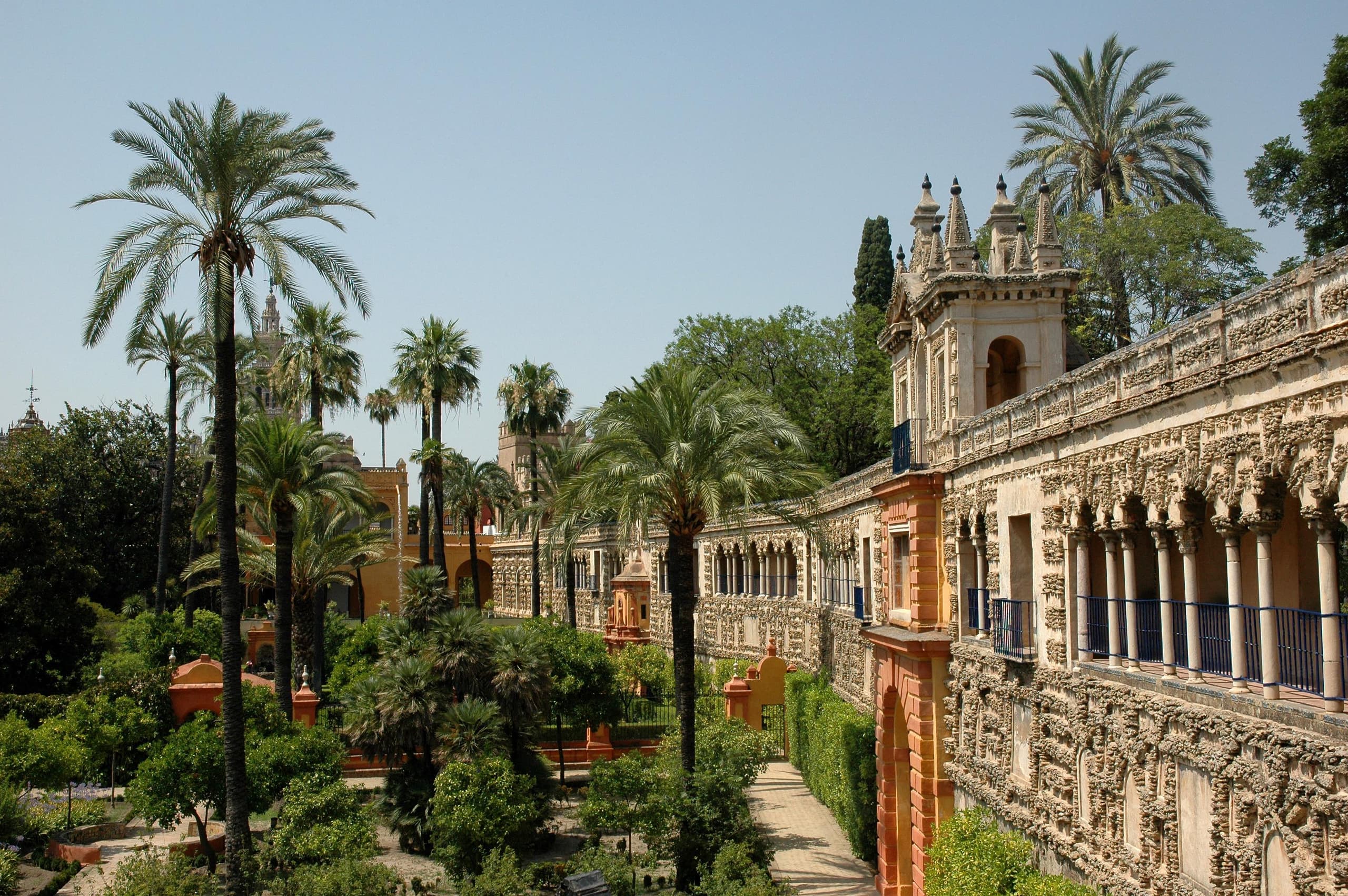
The tour also covers the 14th century, with Pedro I and the construction of the Mudéjar Palace, plus the Patio de las Doncellas built by Nasrid craftsmen sent by Muhammad V. The visit also includes a walk through the Gardens of the Royal Alcázar, taking in spots such as the Gardens of the Prince with its Neptune fountain, the Naranjal Gardens with the Lion fountain, and the Pavilion of Charles V.
Book your guided tour
Want to see it with an official guide telling you about it in person?