Hospital de las Cinco Llagas, home of the Parliament of Andalusia
Written by official guides
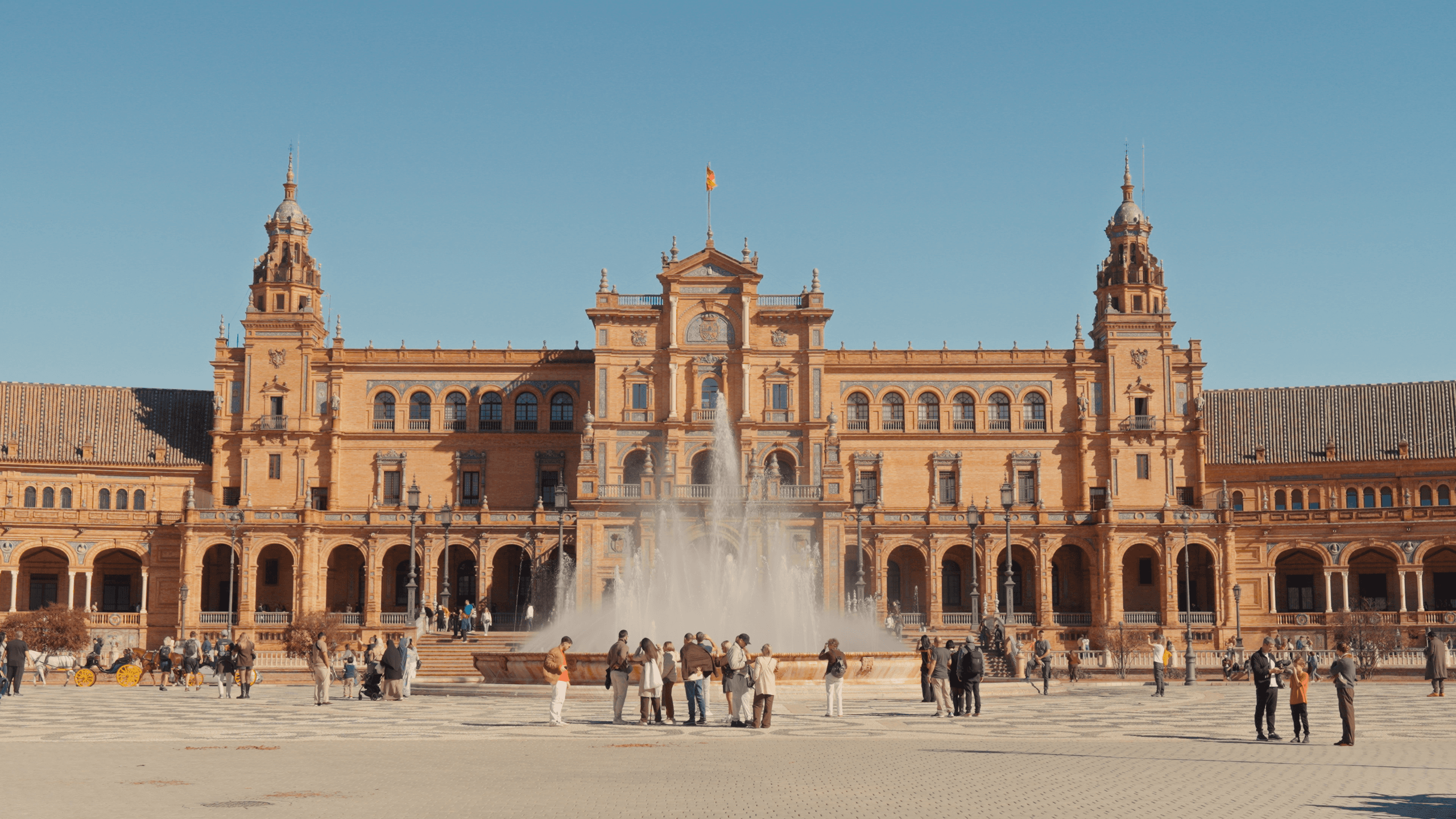
Discover the largest Renaissance building in Spain before El Escorial, today the seat of the Parliament of Andalusia.
Your official guide takes you through the 8 monumental courtyards that ventilated the wards where 3,000 women patients were cared for, the free-standing church by Hernán Ruiz II where the plenary sessions of parliament are now held, and the high altarpiece with 16th-century paintings by Alonso Vázquez.
You will learn the story of Catalina de Ribera, who founded this hospital for poor women in 1500, how Martín de Gainza designed the most ambitious project of the Spanish Renaissance (40,000 m²), why it is called "of the Five Wounds" and how it went from military hospital to becoming, in 1992, the heart of Andalusian democracy.
You will see the sculptural group of Hercules from Expo '92 and understand why this building inspired hospitals all over Europe.
Itinerary of the visit
Departures: 10:00 · 11:30 · 16:00 · 17:30 (subject to parliamentary availability)
First part – Historical context and façade (15 min)
Puerta de la Macarena. We start opposite the Almohad wall where the Huerta de Macario once stood (origin of the name Macarena). Your guide sets the context: 16th-century Seville, port of the Indies with 150,000 inhabitants, wealth and misery side by side. Catalina de Ribera (House of the Adelantados) obtains a papal bull from Alexander VI in 1500 to create a hospital for women.
Renaissance main façade. We admire the 200 metres of façade by Martín de Gainza (1546): three storeys with Doric and Ionic pilasters, windows with alternating pediments (triangular and semicircular), the flamboyant balustrade and the four corner towers (only two completed). We show you where the Lisbon earthquake of 1755 left cracks that are still visible.
Second part – Monumental courtyards (25 min)
Patio del Cardenal. The first of the 10 courtyards planned (9 built, 8 preserved). Double-height galleries with round arches for cross-ventilation. There were 300 beds here in the 16th century.
Central Courtyard (formerly of the Chaplains). The largest, with the entrance to the free-standing church. We explain the original hydraulic system: cisterns, fountains and waterwheels that guaranteed clean water when the rest of Seville drank from the Guadalquivir.
Infirmary courtyards. We walk through the spaces where patients were separated by condition: fevers, surgery, convalescence. The porticoed galleries allowed patients to sit in the sun without leaving the building. We identify the 16th-century stonemasons' marks.
Third part – Church and Plenary Chamber (30 min)
Free-standing church by Hernán Ruiz II. We enter the jewel of the complex (1558): Latin-cross plan, a single nave of two bays, sail vaults, a crossing with a dome on pendentives. It is taller than the rest of the building so as to be seen from all over Seville.
High Altarpiece by Diego López Bueno. We analyse the masterpiece with paintings by Alonso Vázquez (1600) to a design by Asensio de Maeda: the Transfiguration, Saint John the Baptist, Saint Catherine. The original gilding was restored in 2003.
Conversion into the Plenary Chamber. We explain the 1992 adaptation: the seats of the 109 members, the coat of arms of Andalusia in the apse, the presidential table where the high altar once stood. This is where the Statute of Autonomy was approved and where the President of the Junta is elected.
Fourth part – Parliamentary spaces (15 min)
Hall of Lost Steps. The old refectory turned into a meeting area for members. The 18th-century frescoes with scenes of hospital life.
Parliamentary library. The hospital's old pharmacy. It keeps the original mahogany shelves where medicines were stored. Today, 40,000 volumes of parliamentary law.
Finish – Gardens and Hercules (5 min)
We finish in the restored gardens with the impressive sculptural group of Hercules with two lions and the columns, the work of José López-García Seguiri for Expo '92, installed here in 2007. The symbol of the Andalusian coat of arms.
Visits depend on parliamentary activity. There is no access on days of plenary sessions or committees. Availability is confirmed 48 hours before.
DETAILS OF HOW THE VISIT TO THE HOSPITAL DE LAS CINCO LLAGAS WORKS
We will visit the jewel of the Spanish Renaissance, which since 1992 has housed the institution representing the Andalusian people.
Access is conditioned by parliamentary activity, so places are limited and highly sought after.
Length
About 1h 30min (includes courtyards, church/Plenary Chamber and parliamentary spaces)
Languages available
Spanish and English. Visits in French on request with 72 hours' notice.
Includes:
Authorised access to the Parliament of Andalusia
Official guide accredited by the institution
Visit to the 8 preserved historic courtyards
Entry to the church converted into the Plenary Chamber
Explanation of the altarpiece by Alonso Vázquez
Walk through the Hall of Lost Steps and the library
Information material on how parliament works
Availability
Tuesday to Friday. No visits: Mondays, plenary days, parliamentary sessions and regional public holidays
Meeting point
C/ San Juan de Ribera s/n, next to the Puerta de la Macarena
End of the tour
Parliament gardens with the sculptural group of Hercules
Confirmation and voucher
Electronic, by email. ID document compulsory for access (parliamentary security control). Named list 48 hours before.
Group policy:
Minimum 10 people, maximum 60 (divided into 2 groups)
Schools: from year 5 of primary
Cultural associations with prior request
Important:
Dress code: formal/casual (no vest tops or shorts)
No photography in the Plenary Chamber during the explanation
Phones on silent
The visit may be cancelled because of urgent parliamentary activity
CANCELLATION AND CHANGES FOR THE VISIT TO PARLIAMENT
Special conditions, as it is an official institution with strict security protocols.
Cancellation on your part:
Up to 72 h before: 100% refund
Between 72 and 48 h: 50% refund
Less than 48 h: no refund (named list already with security)
Cancellation by Parliament: if there is an extraordinary plenary session or urgent activity, full refund or change of date. We give at least 24 hours' notice.
Important:
No original ID, no entry (parliamentary protocol)
Arrive late = no entry (security closes 10 min after)
Groups of at least 10 people
For individual visits, Parliament offers free tours on Tuesday and Thursday afternoons.
MEETING POINT FOR THE TOUR OF THE HOSPITAL DE LAS CINCO LLAGAS
Start: C/ San Juan de Ribera s/n, main entrance of Parliament
End: Parliament gardens (exit through the same door)
The route begins at the main entrance of the Parliament of Andalusia, opposite the Puerta de la Macarena. It is the imposing 200-metre Renaissance façade, impossible to miss.
Your guide will be waiting with a Parliament identification folder next to the security control. The day before you receive a WhatsApp with an exact photo of the spot and the name of the official guide.
The area has history: this was the site of the Huerta de Macario (origin of the name Macarena), outside the walls of walled Seville. Today it is the heart of the Macarena district, 10 minutes from the Basilica.
The tour ends in the Parliament gardens next to the sculptural group of Hercules. Exit through the same security control. From here you can walk to the Basilica of La Macarena (5 min) or to the centre along the Alameda de Hércules (15 min).
How to get there:
Bus: lines 13, 14, C1, C2 – Parlamento de Andalucía stop
Metro: line 1 to Plaza de Cuba + bus C1 (20 min in total)
Parking: Macarena car park (€5/day) on C/ Resolana
From the centre: 25 min on foot along the walls
REVIEWS OF THE GUIDED VISIT TO THE HOSPITAL DE LAS CINCO LLAGAS
Verified reviews from those who have already visited this monument with us. They especially highlight access to the Plenary Chamber where Andalusia's decisions are made, the magnificence of the 8 Renaissance courtyards and discovering the story of Catalina de Ribera and the largest women's hospital in Europe.
FREQUENTLY ASKED QUESTIONS ABOUT THE HOSPITAL DE LAS CINCO LLAGAS
Why is it called the Hospital of the Five Wounds?
It refers to the five wounds of Christ at the crucifixion (hands, feet and side). Catalina de Ribera, who was very devout, dedicated the hospital to this invocation in 1500. It was also known as the Hospital de la Sangre (of the Blood) for the same religious reference. It was common at the time to name hospitals after invocations of the Passion.
Can it be visited independently or only with a guided visit?
Only with an authorised guided visit. It is the seat of the Parliament of Andalusia, an official institution with strict security controls. Free individual visits are organised directly by Parliament (visitasguiadas@parlamentodeandalucia.es). We handle groups of 10 or more with a specialised guide.
When is the visit to the Parliament of Andalusia free?
Parliament offers free visits on Tuesday and Thursday afternoons for individuals (book 2–3 weeks ahead). For public schools it is also free. Our tour (€28) includes a historian guide, permit management and flexible times with no waiting.
Can you go into the Plenary Chamber?
Yes, it is the highlight of the visit. You will see where the 109 members sit, the presidential table and the 16th-century altarpiece by Alonso Vázquez. Access is not possible during plenary sessions (usually Thursdays).
How much of the original building survives?
Approximately 85% is original 16th-century fabric. 8 of the 9 courtyards built survive, along with the complete church by Hernán Ruiz II, the façades by Martín de Gainza and the hospital galleries. The 1986–2003 restoration respected the historic structure.
What is its connection with La Macarena?
The hospital was built on the Huerta de Macario, origin of the name Macarena. It stands opposite the Puerta de la Macarena in the walls. The Basilica of La Macarena (home of the Virgin) is a 5-minute walk away.
Did it really work as a hospital?
Yes, for 431 years (1546–1977). First as a hospital for poor women, then as a Military Hospital (19th century) and finally as the Central Hospital. It came to have 3,000 beds at its peak. It closed in 1977 because of poor conditions.
Who were the architects?
Martín de Gainza (1546–1556) designed the project and built the courtyards and façades. Hernán Ruiz II (1558–1570) completed the free-standing church. He is the same Hernán Ruiz who crowned the Giralda. Diego López Bueno made the high altarpiece (1600).
Why is it so important architecturally?
It is the largest Renaissance hospital building in Europe (40,000 m²). Its design of courtyards for ventilation was copied in hospitals all over Europe. The free-standing church in the central courtyard is unique in Spanish hospital architecture. It preceded El Escorial as a great Renaissance project.
INSTANT CONFIRMATION AND SECURE PAYMENT
Secure payment by card, Bizum or PayPal. Instant confirmation with a QR code straight to your phone.
24 hours before you receive a WhatsApp with a photo of the meeting point and the guide's contact. Your name will already be on the Parliament security list – just bring your original ID.
We handle all the parliamentary permits. Final price with no surprises. If there is an unexpected plenary session, we let you know and refund you in full.
Only 60 places a day because of security protocol. Fridays and school groups sell out fast.
Book your guided tour
Want to see it with an official guide telling you about it in person?